Non-Destructive Testing Service
At SIT,Non-destructive testing ensures the safe and efficient operation of your equipment and assets by detecting defects before they result in severe damage, and assures compliance with international standards.
What is Non-Destructive Testing (NDT)?
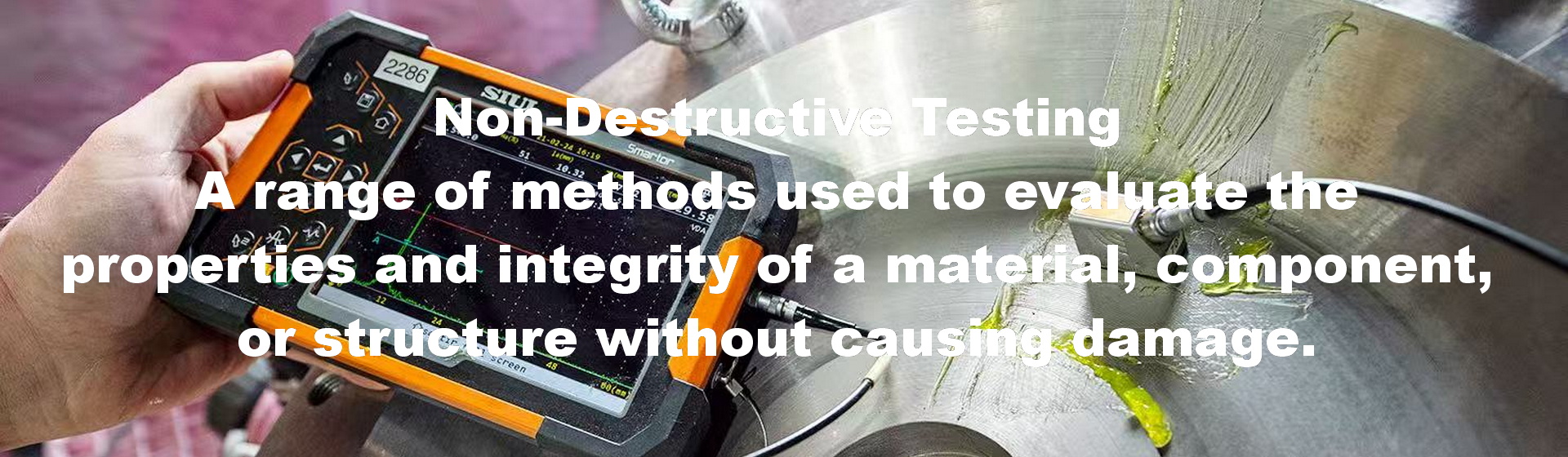
Non-destructive testing (NDT) refers to quality assurance and material examination techniques that preserve the integrity of inspected materials, components, and assets.
Industrial assets such as oil storage tanks, lightning prevention systems on wind turbines, piping, and supporting pylons require regular examination for maintenance and regulatory purposes. NDT inspections identify defects, flaws, irregularities, or wear and tear in structures to ensure safety and robustness
Non-destructive testing is the only way to get high-fidelity material characteristics of an asset without damaging it.
The most common types of non-destructive testing methods assume the usage of sound waves, acoustic impulses, or gamma rays to perform in-depth material assessments. By combining different methods, NDT technicians can test objects for the smallest cracks, voids, or weld discontinuities, invisible to the naked eye.
Types of materials you can test with NDT:
• Metals
• Alloys
• Plastics
• Ceramics
• Composites
• Concrete
• Coatings
• Wood
• Glass
• Fiberglass
• Rubber
• Electronic components
• Weldments
• Pipelines
• Castings
• Forgings
• The Importance of Non-Destructive Testing
NDT serves two primary purposes: quality control and asset maintenance.
Aerospace and automotive companies have little margin for error when developing new product components. Aircraft engine turbine blades must operate under extreme temperatures and pressure while maintaining optimal speeds. Quality assurance engineers use NDT techniques like ultrasonic testing (UT) or radiographic testing (RT) to inspect the blades for material inconsistencies or cracks after crash tests to ensure durability. NDT allows inspection without interfering with a product’s final use, balancing quality control and cost-effectiveness.
Regular NDT assessments are a compliance requirement in many industries. Operators of oil rigs, power plants, and chemical facilities must comply with safety standards and ensure assets don’t leak, deform, or degrade to the point where they become hazardous.
Magnetic particle testing is used to detect surface-level cold cuts or shrinkage cracks in castings, forgings, and metal components. Eddy current testing is a good method for detecting early signs of corrosion or material loss in pipelines, boilers, and storage tanks.
Early issue detection prevents costly leaks, deformations, and sudden equipment failures. Fortune Global 500 manufacturing and industrial firms lose over $1.5 trillion yearly to unplanned downtime. Regular NDT testing helps avoid operational failures, save on repairs, and extend assets’ lifespan.
Industries relying on NDT for asset evaluations and inspections:
Aviation & aerospace
Automotive
Oil & gas
Manufacturing
Power generation
Infrastructure
Telecom
Mining
Chemicals
Construction
Rail & transportation
Marine & shipbuilding
Most Common NDT Methods
The following methods are the most commonly used in the field of NDT, each offering unique advantages for detecting and evaluating defects:
> Electromagnetic Testing (ET)
Includes techniques such as eddy current testing, which uses electromagnetic induction to detect flaws in conductive materials. It is commonly used in aircraft maintenance and the inspection of thin-wall tubing.
> Magnetic Particle Testing (MT)
Used to locate surface and near-surface discontinuities in ferromagnetic materials. It involves magnetizing the part and applying ferromagnetic particles to reveal defects.
> Liquid Penetrant Testing (PT)
Reveals surface discontinuities in solid and nonporous materials. A liquid penetrant is applied to the surface, which seeps into cracks and cavities, making them visible under ultraviolet or visible light.
> Radiographic Testing (RT)
Uses X-rays or gamma rays to create images of the internal structure of a component. It is primarily used to inspect castings, weldments, and mechanical assemblies for internal defects.
> Ultrasonic Testing (UT)
Employs high-frequency sound waves to detect surface and subsurface discontinuities. It is widely used for inspecting pressure vessels, machinery, and bridges.
> Visual Testing (VT)
The most basic NDT method, involving the direct inspection of a component using the naked eye or optical aids. It is often the first step before applying other NDT methods.
Why Choose Non-Destructive Testing from SIT?
SIT offers you the most effective NDT methods to investigate the integrity of your equipment and assets. Our comprehensive range of NDT methods can help you:
Monitor the integrity of your assets using intrusive or non-intrusive methods
Detect defects and irregularities before they result in severe damage or non-compliance
Save time and money through fast and effective testing of your assets and equipment at every stage of their lifespan – from manufacturing through to on-site operation
Ensure safe and reliable operation of your facilities.
With the right NDT solution you can save costs and improve production output and sustainability
With our NDT solutions you can tackle the key challenges – while the equipment is being manufactured, during plant shutdown or on-stream – in order to improve production output, save overall maintenance costs as well as ensure safe and reliable operating processes.
The selection of the right NDT solution depends on many factors. On the one hand, the focus for manufacturers of new equipment might be on efficient inspection methods to prove that the produced materials and equipment meet the quality requirements at the lowest production cost in the whole value chain. On the other hand, asset operators are interested in the inspections, which are mainly focused on in-service material deterioration because of corrosion and process reactions.
Benefits of Our NDT Services at SIT
You need to be cost effective while ensuring quality and keeping your equipment up and running to meet production targets and deadlines. With non-destructive testing services from SIT your benefits include:
Minimize health, safety and environmental (HSE) risks
Reduce manufacturing and construction costs
Reduce plant downtime and the probability of unplanned shutdowns
Prevent major damages by detecting smaller flaws at an early stage
Increase the availability of your equipment and use the full production capacities
Reduce risk of company liability and reputation damage
Comply with design specifications and receive documented evidence of compliance
Exclusive one-stop service from an independent third party inspector.